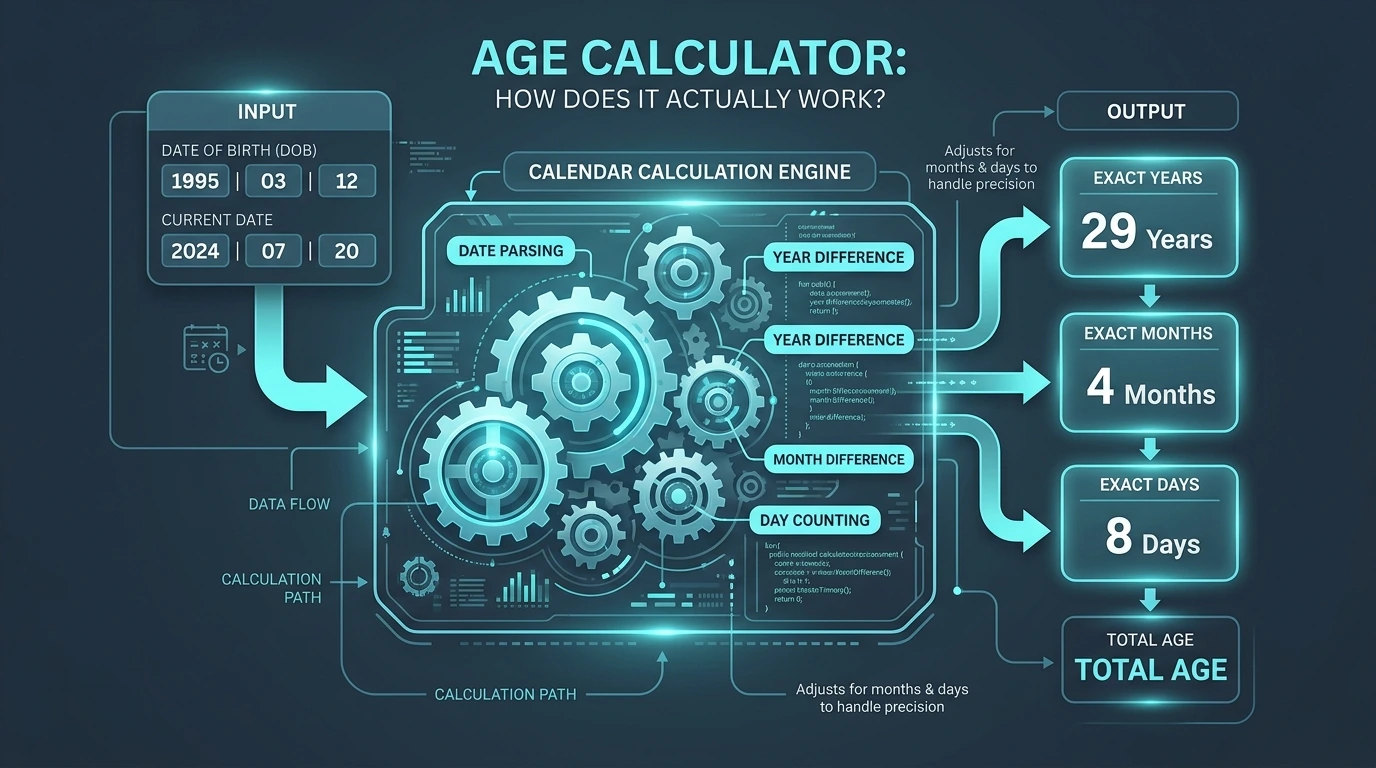
The question behind the calculator
When people search for “Age Calculator: How Does It Actually Work?,” they usually want an answer that is easy to check, not a page full of arithmetic jargon. The useful starting point is the dates themselves. A date of birth establishes one point on the calendar; the date being investigated establishes another.
The result depends on which two dates are compared and what the reader means by age. A conventional age is normally expressed in completed calendar years. A more detailed result can include months and days, while an elapsed-time result can be expressed in days, weeks or smaller units. Those representations are related, but they are not interchangeable.
Start with complete dates
For an exact result, use the day, month and year rather than relying on the birth year alone. The month and day determine whether the birthday has occurred in the reference year, which is why year subtraction can be off by one.
This is particularly important for an international audience. A numeric date can be interpreted differently in different countries. Clearly labeled Day, Month and Year fields remove that ambiguity and make the calculation easier to trust.
Why calendar details matter
Calendar months have different lengths, and leap years introduce February 29. An exact calendar calculation therefore should work from the actual dates rather than assuming that every month has 30 days or every year has exactly 365 days.
The same principle applies when the calculation is moved away from today. A historical date and a future date are both valid reference points; the answer changes because the endpoint changes.
A practical example
Imagine a person born on October 20, 2000. On September 1, 2026, the year difference is 26, but the October birthday has not arrived, so the completed age is 25. On October 20, the completed age becomes 26.
This simple example explains most disagreements between mental calculations and date calculators. The arithmetic is not difficult. The important part is using the complete date and checking the birthday.
Common mistakes to avoid
The most common mistake is treating the difference between two years as the final answer. Another is entering an ambiguous date without checking the format. A third is converting calendar months into a fixed number of days and then calling the result exact.
A good calculation uses the precision the question actually needs. If the reader needs a whole-year age, do not pretend that seconds are necessary. If the reader needs an exact calendar interval, do not hide the month and day information.
What to check before publishing
Test the live calculator with dates immediately before and after birthdays, month boundaries, leap years, February 29, historical dates and future dates. Verify any time-zone behavior and any special rules implemented by the site. Do not claim independent testing unless it has actually been performed.