Age Calculator
Calculate Your Exact Age From Your Date of Birth
How old are you today?
Enter your date of birth and find out your age in years, months, and days.
Our age calculator helps you calculate your current age from your date of birth, check how old you were on a particular date, find your age on a future date, and understand the difference between two dates of birth.
Whether you are checking your age for yourself, comparing the ages of two people, planning for a birthday, or simply curious about how many days you have been alive, the calculator gives you a straightforward way to work with dates.
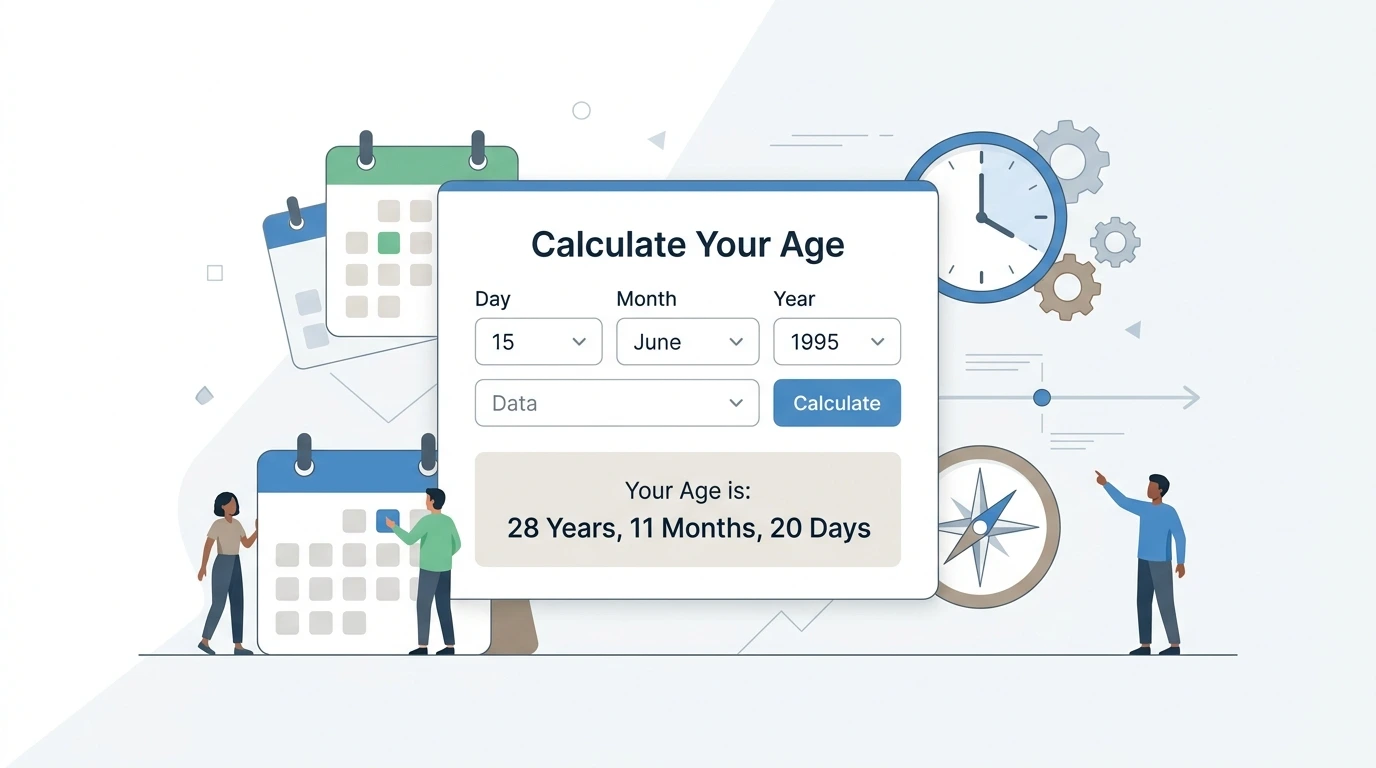
How old am I?
It sounds like one of the easiest questions to answer.
Most of the time, you probably know the answer without calculating anything. But an exact age is slightly more complicated than subtracting your birth year from the current year.
Your birthday matters.
If you were born in November and today's date is in September, you have not reached this year's birthday yet. A simple subtraction of the two years would therefore give you an answer that is one year too high.
The same issue appears when you want your age in years, months, and days, rather than completed years alone.
That is why an age calculator works with the complete date of birth instead of looking only at the birth year.
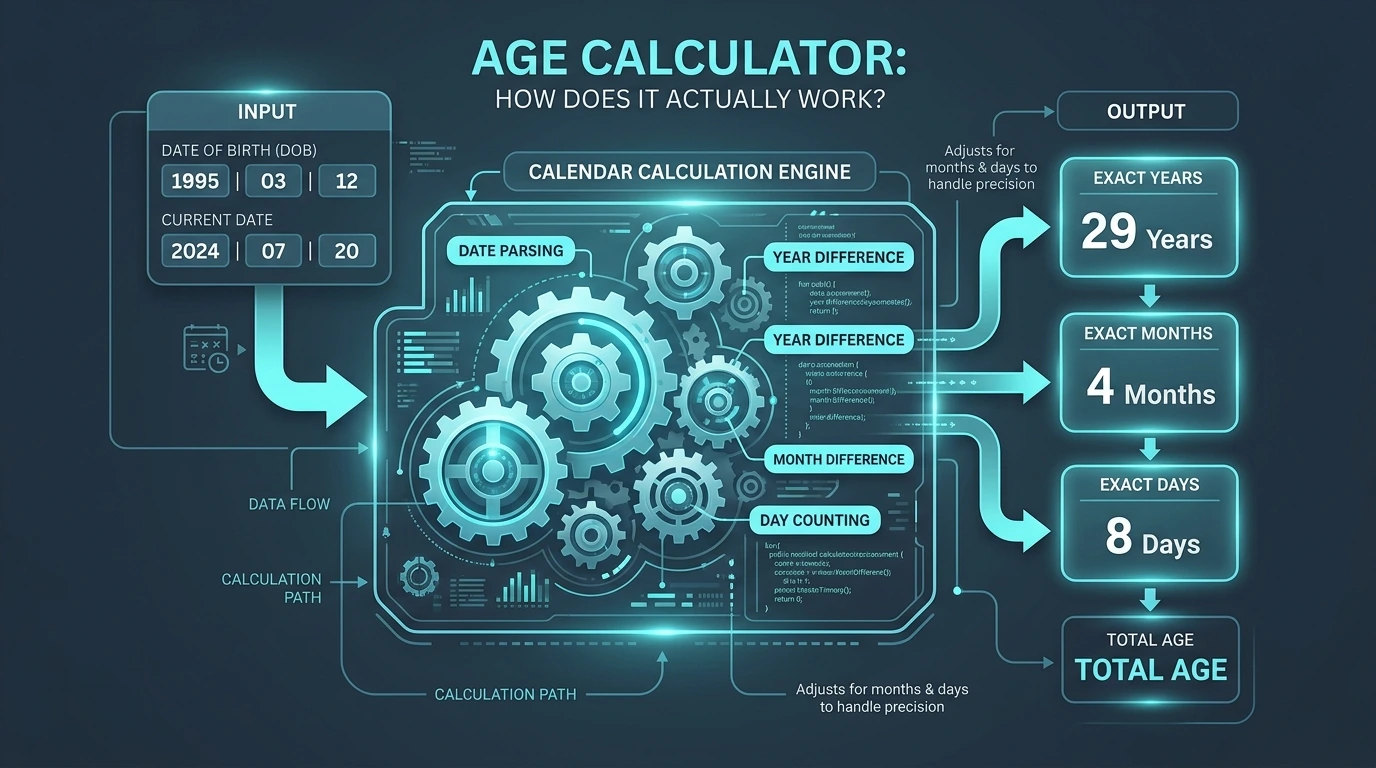
Enter your birthday, and the calculator can determine the relationship between that date and the date being used for the calculation.
For a normal “how old am I?” calculation, that means comparing your date of birth with today's date.
If you want to know how old you were when something happened, or how old you will be on a future date, you can instead use that specific date as the reference point.
What is an age calculator?
An age calculator is an online date calculation tool that determines a person's age from their date of birth.
The most familiar result is an age in completed years: 25 years old
But an exact age can contain more information: 25 years, 4 months, and 12 days
The first result is usually enough for everyday conversation.
The second is useful when you need to know precisely how much calendar time has passed since the person's most recent birthday.
An age calculator can also provide other representations of the same period, depending on the features available. These may include total months, weeks, days, hours, minutes, or seconds.
Those measurements should not be confused with one another.
A person can be 25 years old while also having lived through a much larger number of days. The number of days is an elapsed-time calculation; the number of completed years is a conventional calendar-age calculation.
The distinction becomes especially important when you are working with dates around birthdays, February 29, leap years, or month boundaries.
How does an age calculator calculate your age?
The calculation begins with two dates.
The first is your date of birth. The second is the date on which you want to know your age.
For a current age calculation, the second date is normally today.
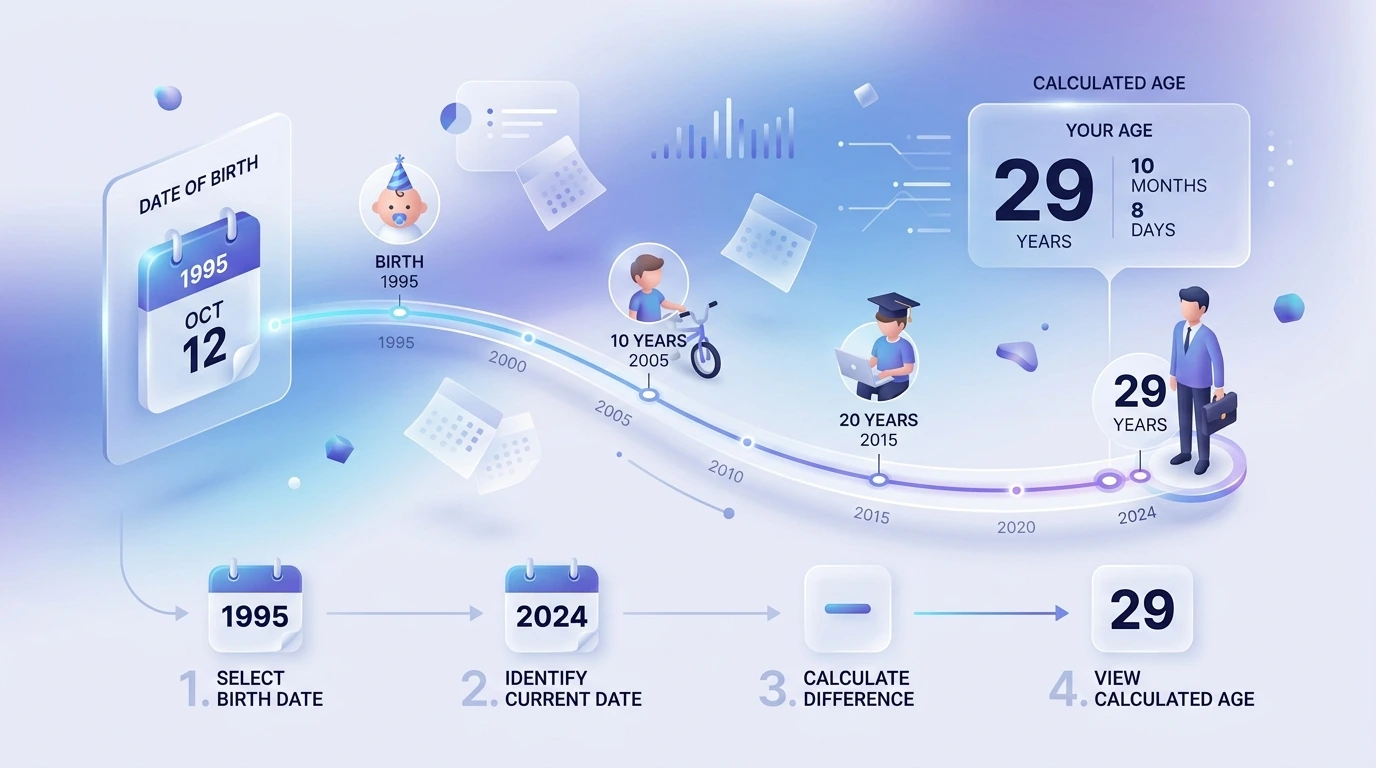
The simplest year-based calculation looks like this: Current year − birth year
But that is only a starting point.
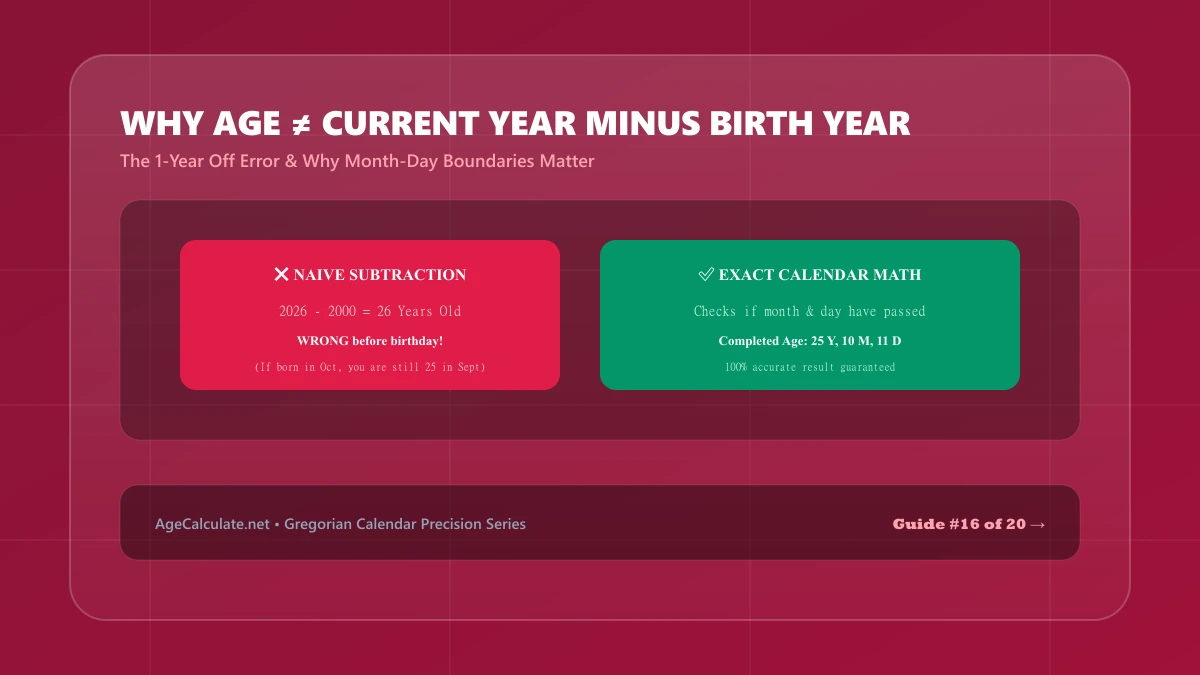
Suppose someone was born on October 20, 2000. If the calculation date is September 1, 2026, the difference between the years is 26. But the person's October birthday has not happened yet. So the completed age is still: 25 years. When the date reaches October 20, 2026, the person turns: 26 years.
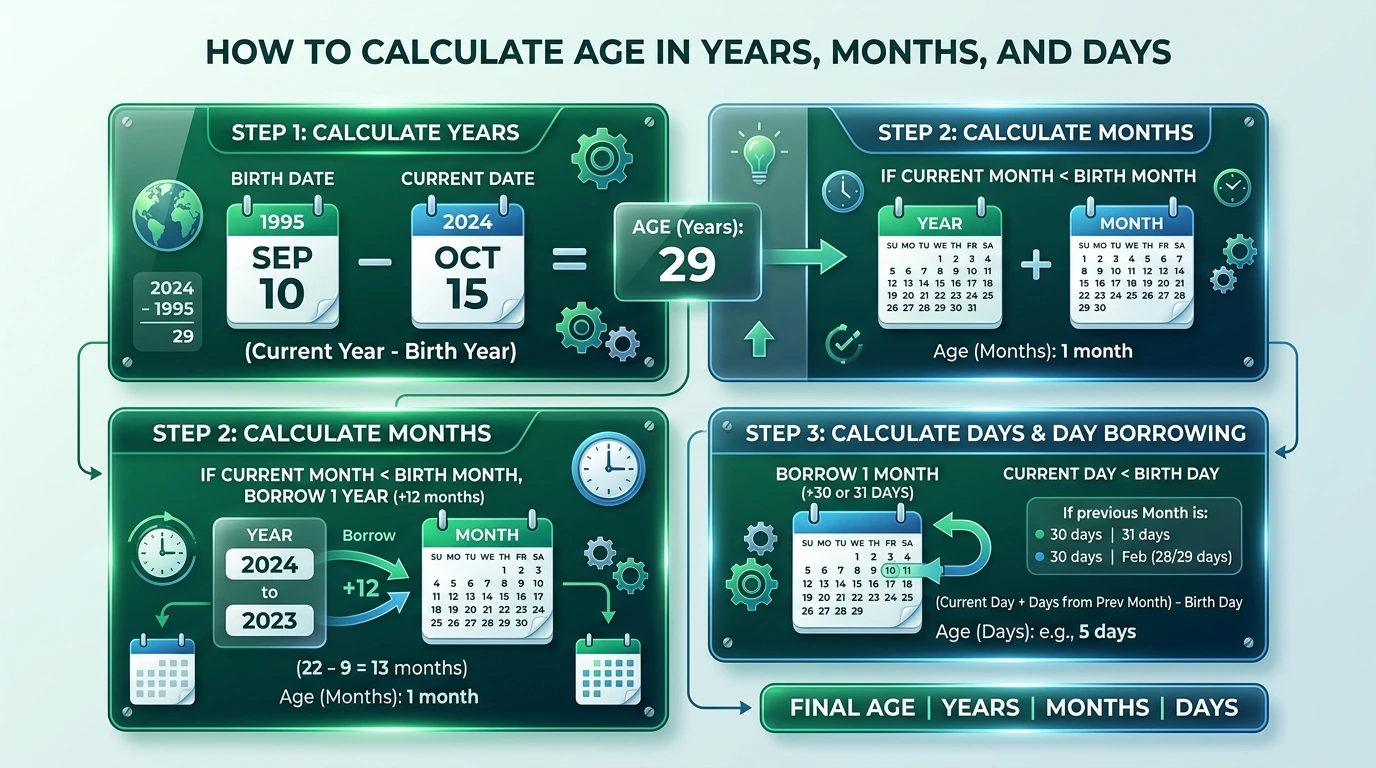
An exact age calculation continues beyond that basic adjustment. It considers the months and days between the relevant dates.
This is why a proper date-based calculation is more useful than simply subtracting two years.
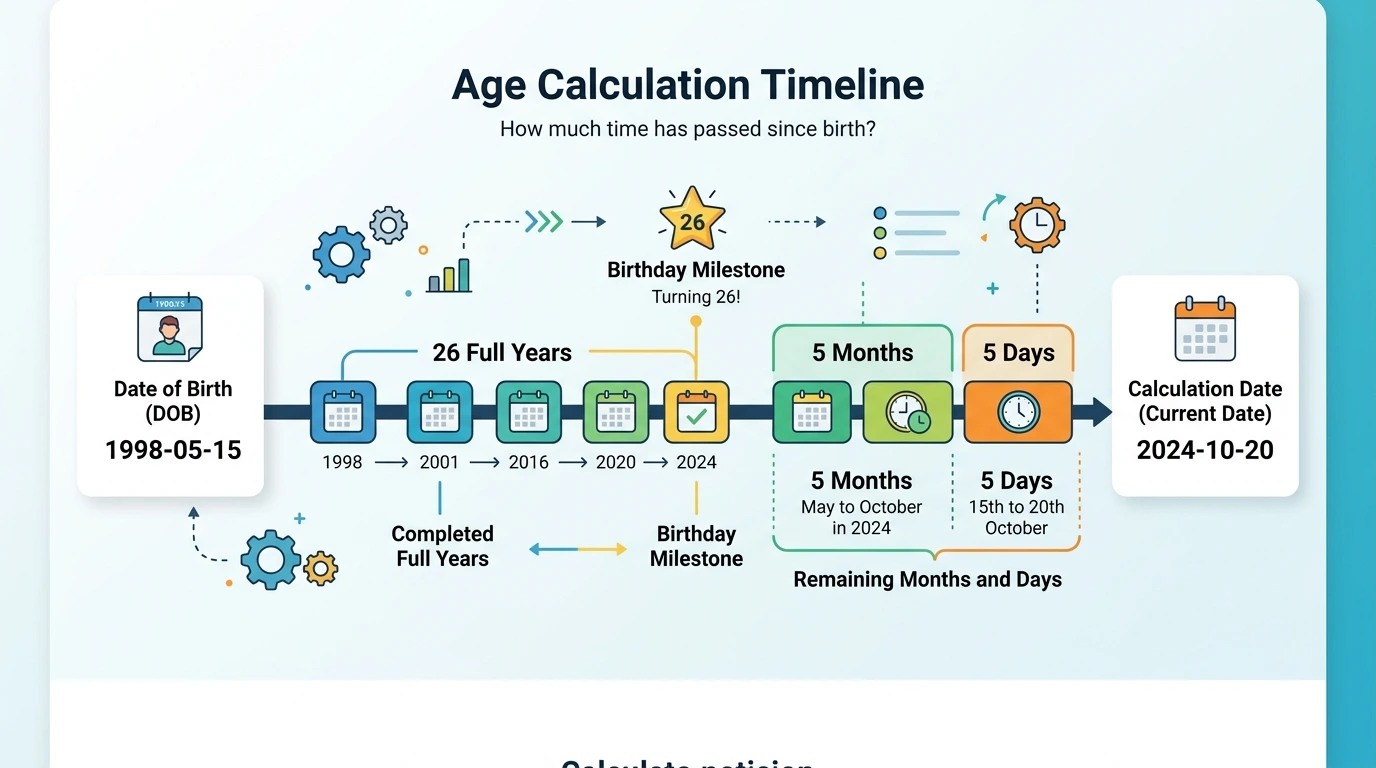
Calculate your exact age in years, months, and days
For many people, this is the most useful result an age calculator can provide. Instead of seeing only a completed year, you can see where you are between birthdays.
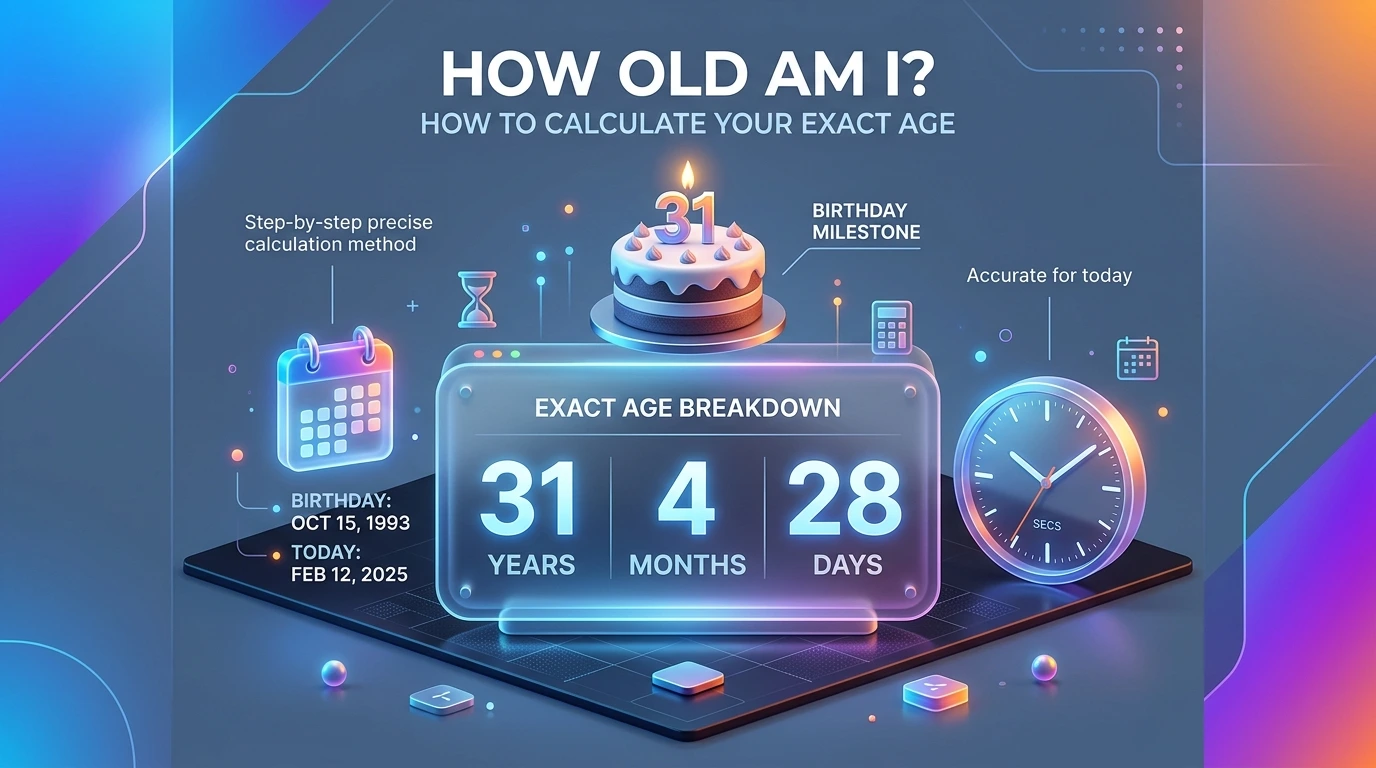
For example, an age result might look like: 31 years, 2 months, 14 days
That means the person has completed 31 years and has lived through another two months and 14 days since their most recent birthday.
The exact result depends on the dates being compared. This matters because calendar months do not all contain the same number of days. January has a different length from February, and February itself can contain either 28 or 29 days.
An age calculator therefore needs to work with actual calendar dates rather than treating every month as an identical block of time. That is also why using an average number of days per month is not a good way to describe a person's exact calendar age.
Age calculator from date of birth
Your date of birth contains three pieces of information: Day + Month + Year (e.g. 15 August 1992).
The year tells us when you were born, but the month and day determine when your birthday occurs. That distinction can change your completed age.
Imagine two people who were both born in 1992. One was born on January 5; the other was born on December 20. At a point in the year before December 20, those two people may not have reached the same completed age even though their birth years are identical.
A date of birth calculator avoids that ambiguity by using the full date. For the most reliable result, enter the day, month, and year rather than entering only the year of birth.
Why your birthday changes your age
Your age does not increase simply because the calendar moves from December to January. It increases when you reach the anniversary of your birth date. That is an easy detail to overlook when calculating age manually.
Suppose you were born on May 10, 1995. On May 9, 2026, you have not yet reached your 31st birthday. On May 10, you have. The difference is only one day, but the completed-year age changes.
This is the basic reason that a calculation such as 2026 − 1995 = 31 cannot automatically be used as the answer throughout the entire year. You must also ask: Has the birthday occurred yet? An age calculator handles that part of the calculation for you.
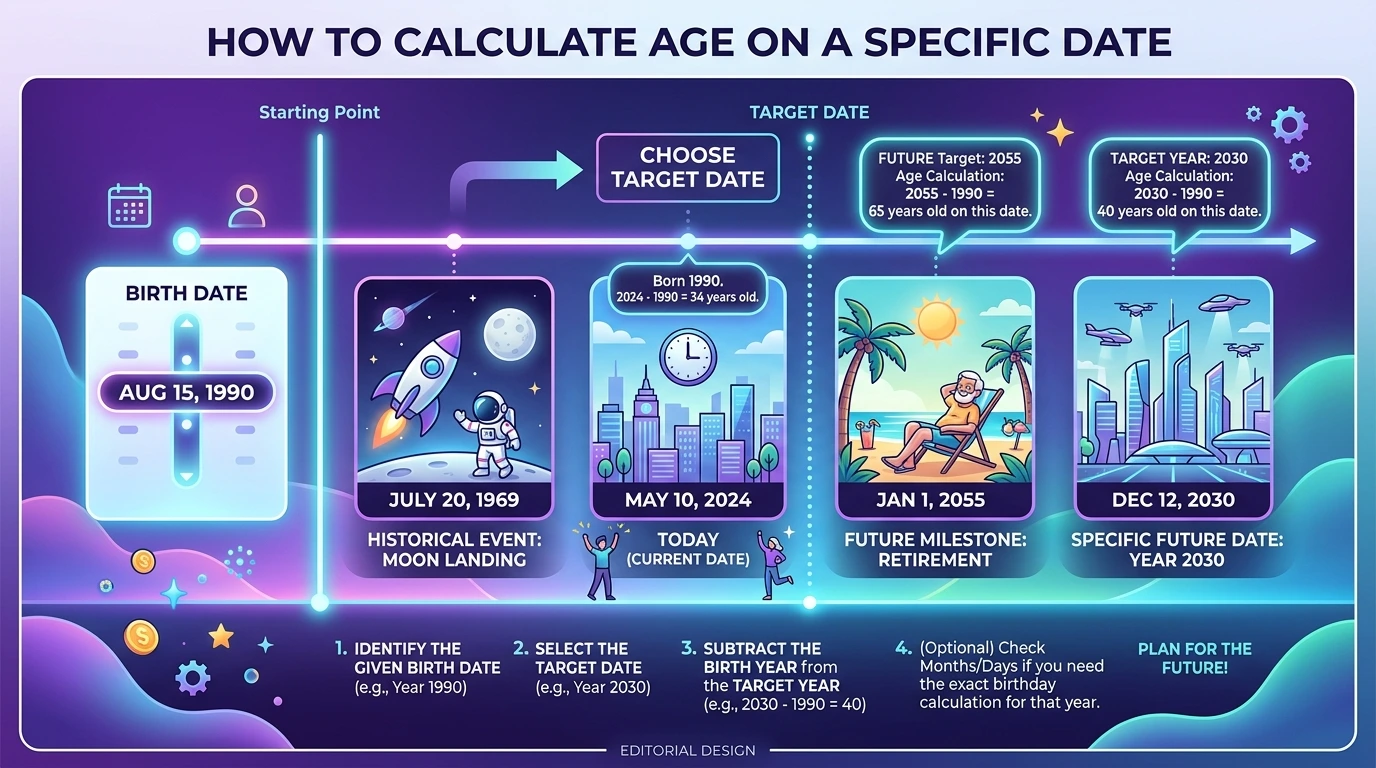
How to calculate age on a specific date
Sometimes “How old am I?” is not actually the question. You may instead want to know: How old was I on a particular date?
That could be the date you started school, graduated, got married, started a job, moved to another country, attended an important event, or reached a particular milestone.
The same calculation works for future dates. You might ask: How old will I be on January 1, 2030?
In that situation, today's date is not the relevant reference point. The calculator compares your date of birth with January 1, 2030. This turns an age calculator into a useful date-based tool rather than something that can only answer your current age.
When using a custom date, make sure the reference date is clearly identified. The answer can change completely when the calculation date changes.
How old was I on a certain date?
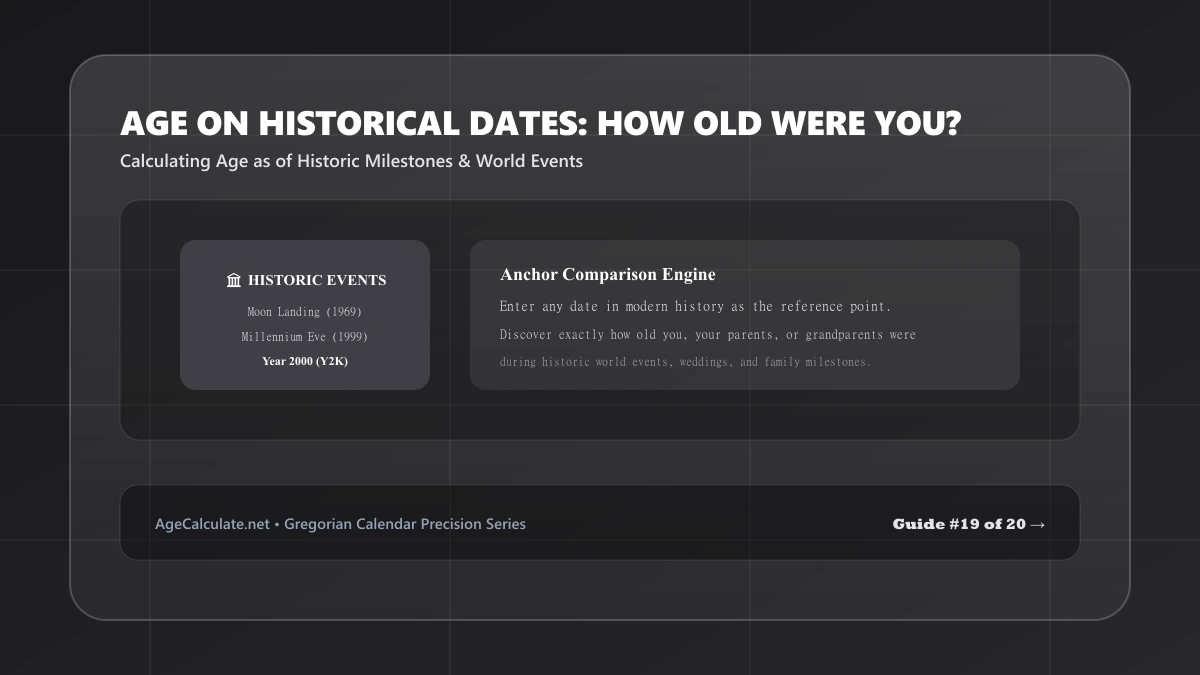
This is simply the historical version of the same calculation. Enter your date of birth, then choose the date you want to investigate (e.g. January 1, 2020). The calculator compares your birth date with that date and determines the completed age at that point.
The important thing is that the calculation does not use today's date unless today is actually the date you want to investigate. This can be useful when looking back at personal milestones or trying to put an event into perspective. Instead of estimating your age from memory, you can calculate it directly from the dates.
How old will I be on a future date?
The same principle works in the other direction. Choose a future date and compare it with your date of birth (e.g. DOB: July 15, 2000; Future date: July 15, 2030).
The person will have reached the corresponding birthday on that date. If the future date falls before the birthday in that year, the completed age will be one year lower than the simple year difference. This is useful when planning future milestones, birthdays, anniversaries, or other events tied to age.
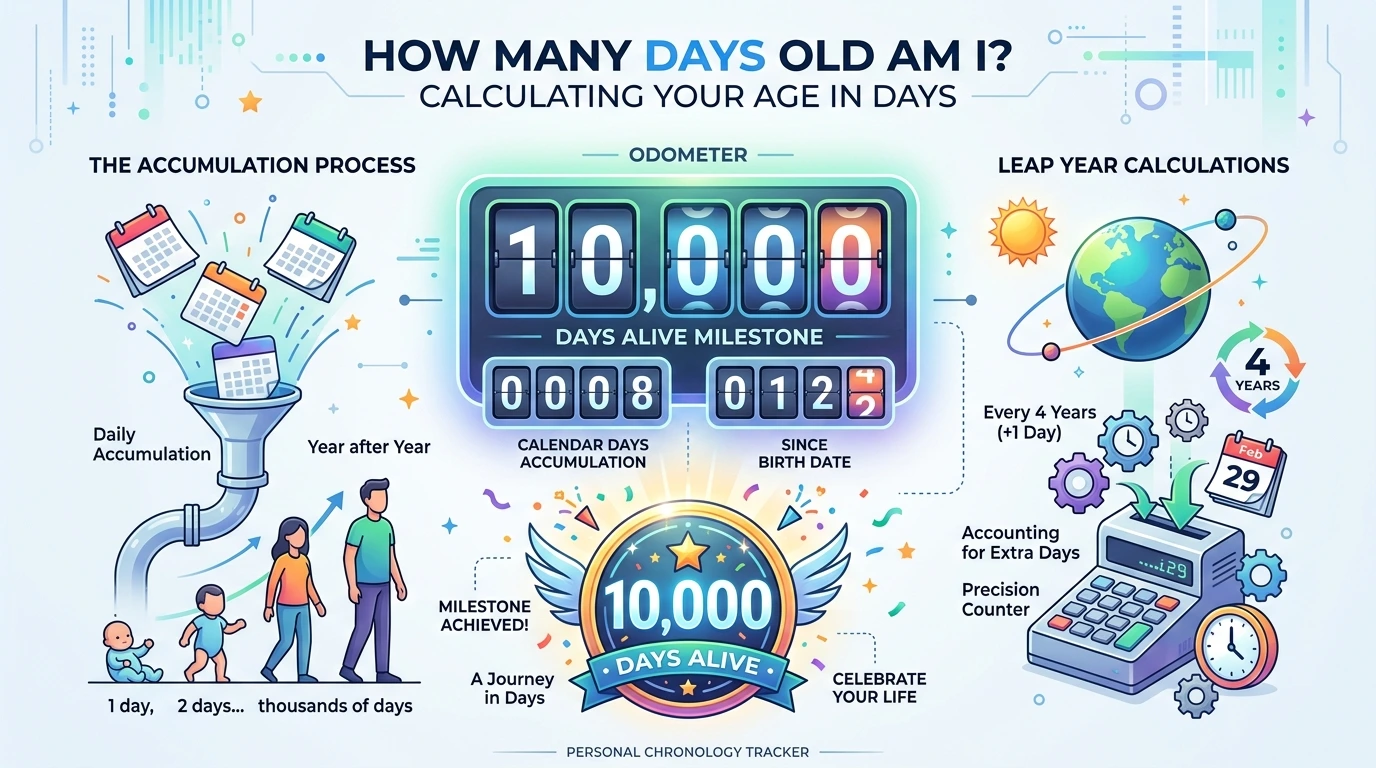
Calculate your age in days
Years are the most familiar way to describe age, but sometimes you may want the total number of days that have elapsed since your birth. That is a different kind of calculation.
To calculate age in days, the calculator determines the number of calendar days between your date of birth and the selected calculation date. This can be interesting for personal milestones: How many days have I been alive? or How many days old is my child?
The answer depends on the actual dates. Leap years matter here because some calendar years contain February 29. That means you should not estimate the number of days simply by multiplying the number of years by 365. For an exact elapsed-day calculation, the actual dates should be used.
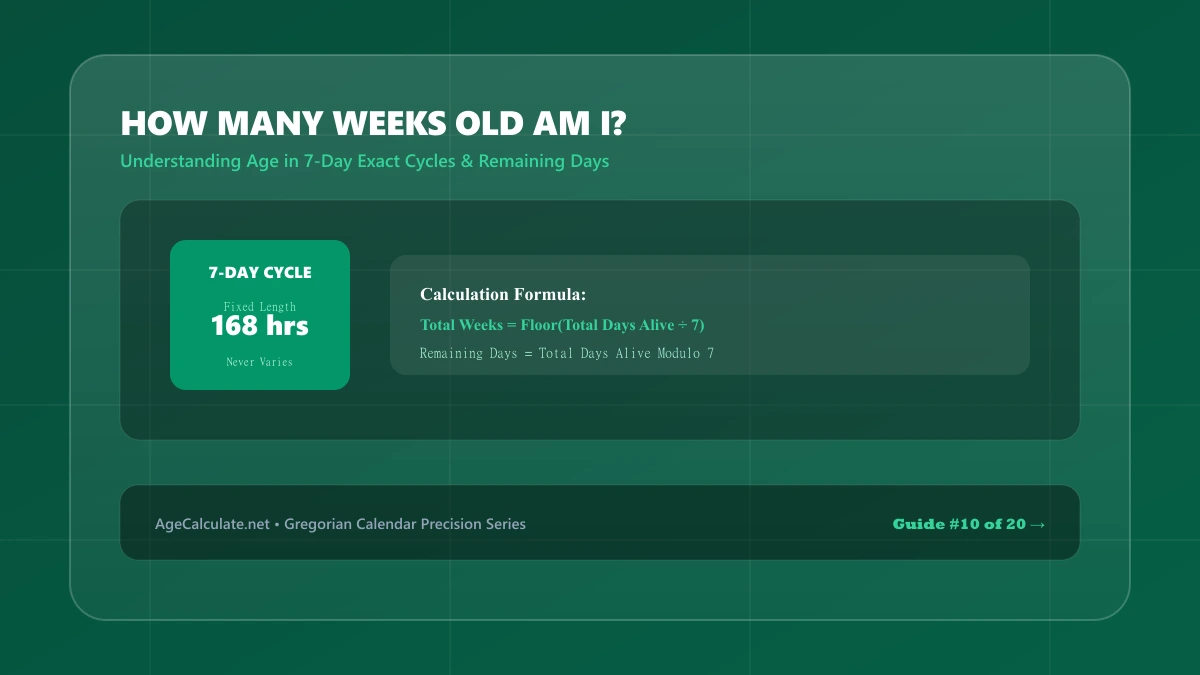
Calculate your age in weeks
Weeks provide another way of looking at elapsed time. This can be particularly useful for very young children, where age is often discussed in weeks rather than years.
The calculator can determine the elapsed period and express it in weeks when that feature is available. There is an important distinction, however: a calendar month is not a fixed number of weeks. Similarly, one calendar year does not always contain exactly the same number of days. So if you want a precise answer, use the actual dates rather than trying to convert years or months into weeks using a fixed approximation.
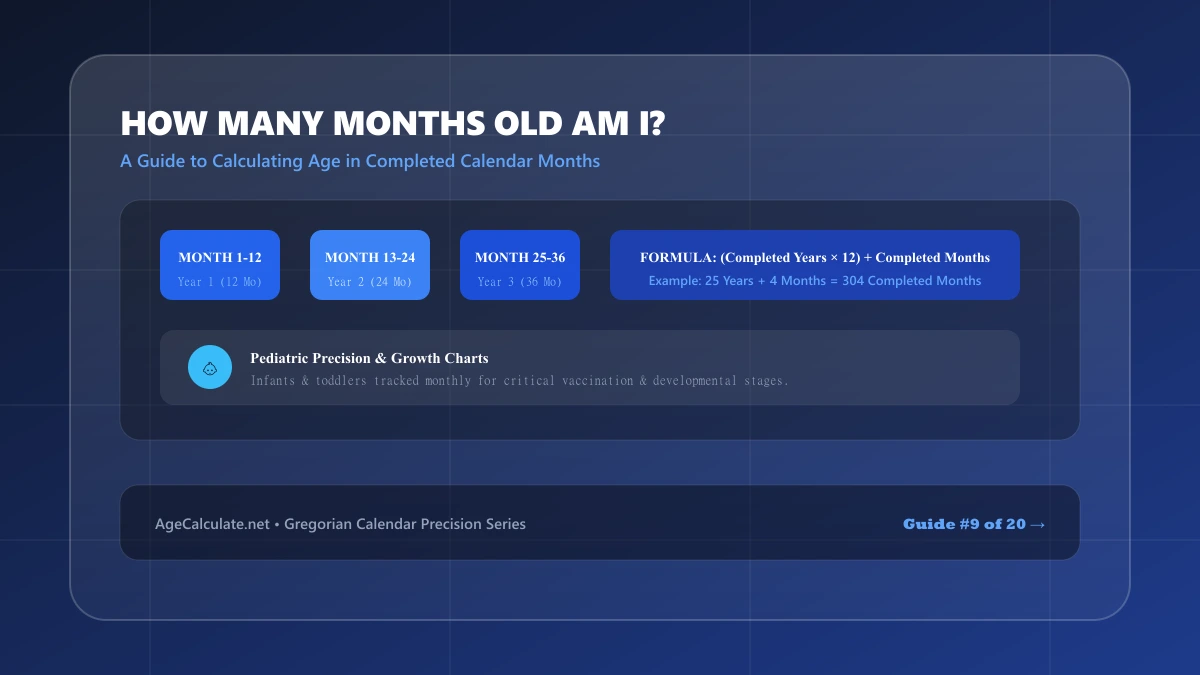
Calculate your age in months
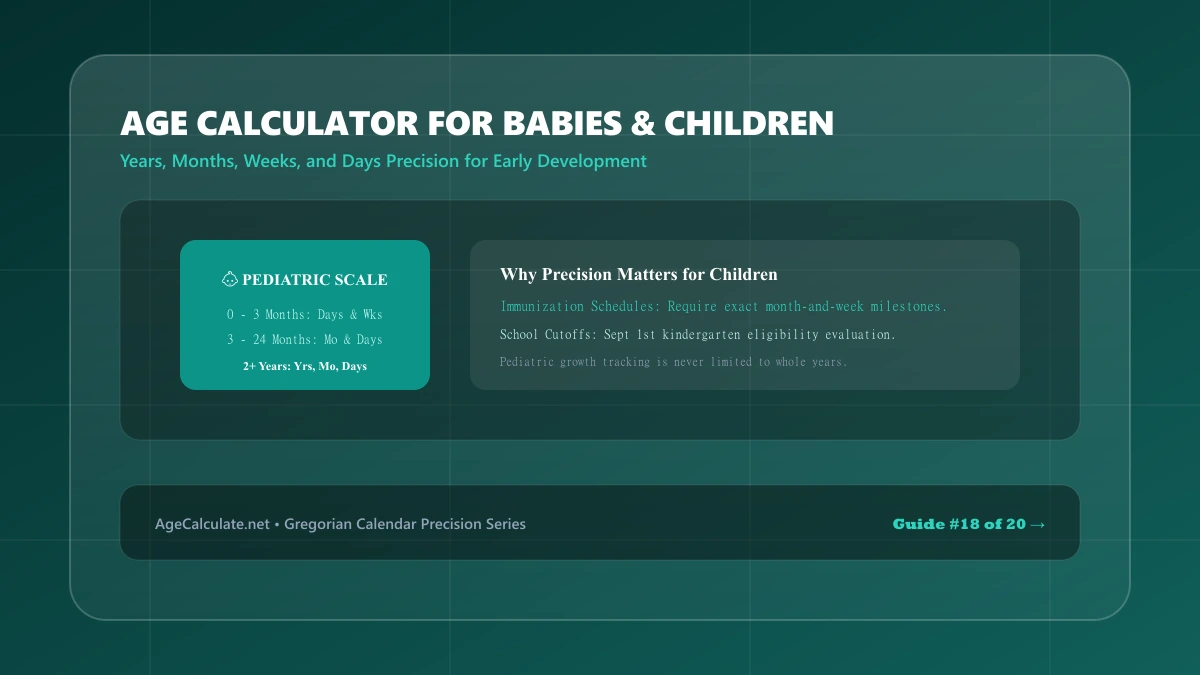
Age in months can be useful when years are too broad to describe a period accurately. This is common when talking about babies and young children (e.g. saying a child is 14 months old communicates something different from simply saying the child is one year old).
For older ages, however, “years and months” is usually easier to understand than a large total-month number. If you want a conventional age, use years. If you want more calendar precision, use years, months, and days. If you want elapsed time, use days or another smaller unit.
Age in hours, minutes, and seconds
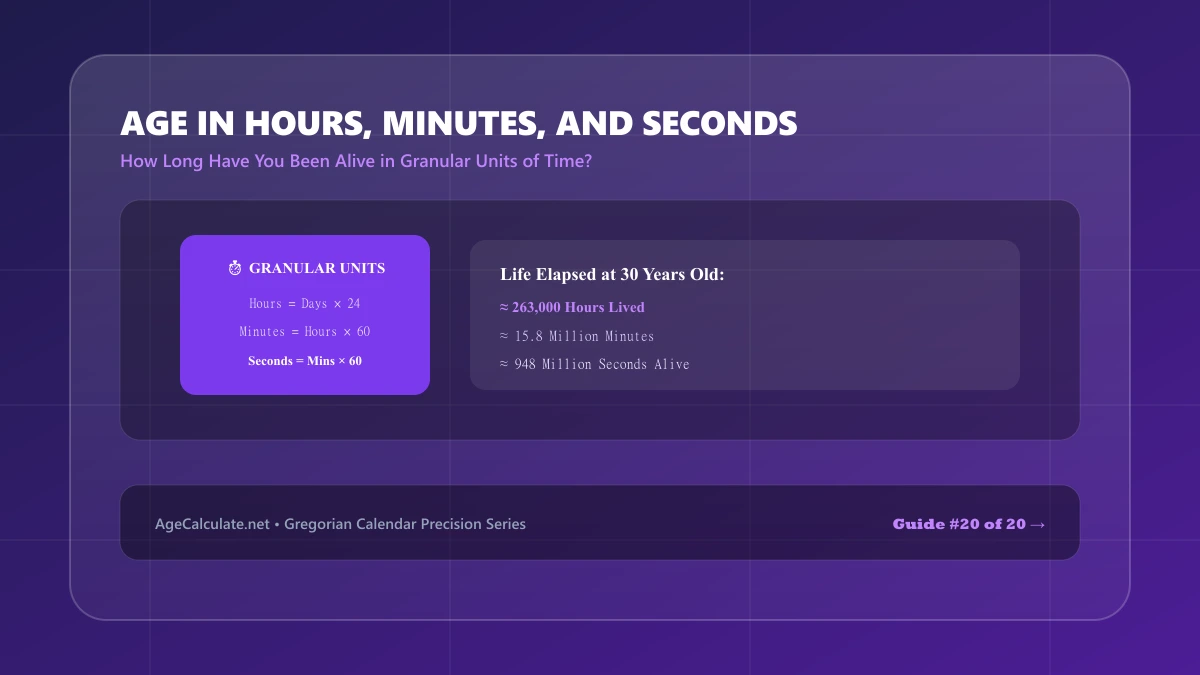
Some age calculators also allow you to express elapsed age in smaller units. That can produce results such as hundreds of thousands of hours, or an even larger number of minutes or seconds.
These numbers can be fun to explore, but they should be understood as elapsed-time measurements rather than conventional age. For normal age questions, years, months, and days are usually much easier to understand. The smaller units are best treated as additional information.
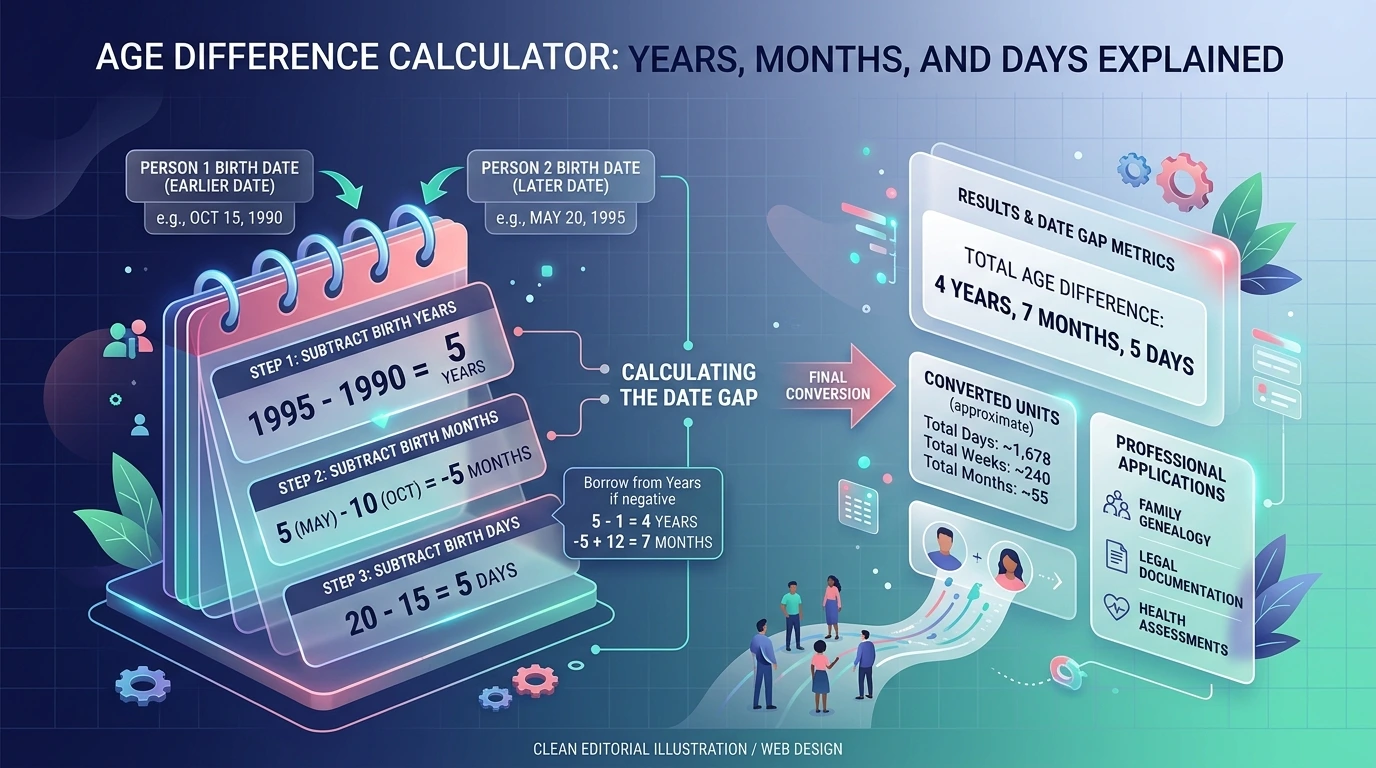
Age difference calculator
An age calculator can also help compare two people. Suppose you want to know: How many years apart are we?
You need two dates of birth. The calculation compares the two dates rather than simply subtracting the birth years. For example: Person A born January 10, 1990; Person B born June 25, 1994.
A quick calculation tells you that the birth years are four years apart. But the actual dates show that the complete difference is more precise than simply saying “four years.” This is why an age difference calculator is useful when you need to know exactly how much older or younger one person is than another.
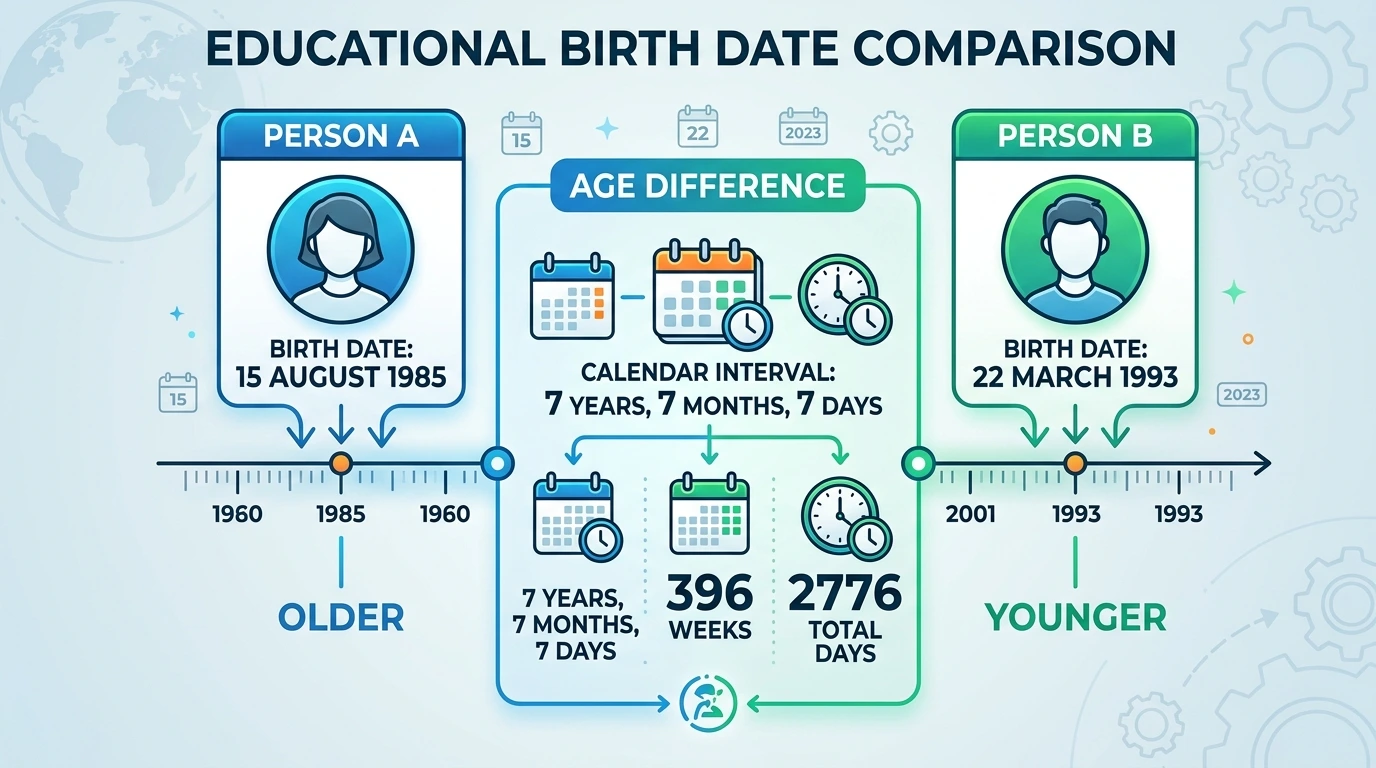
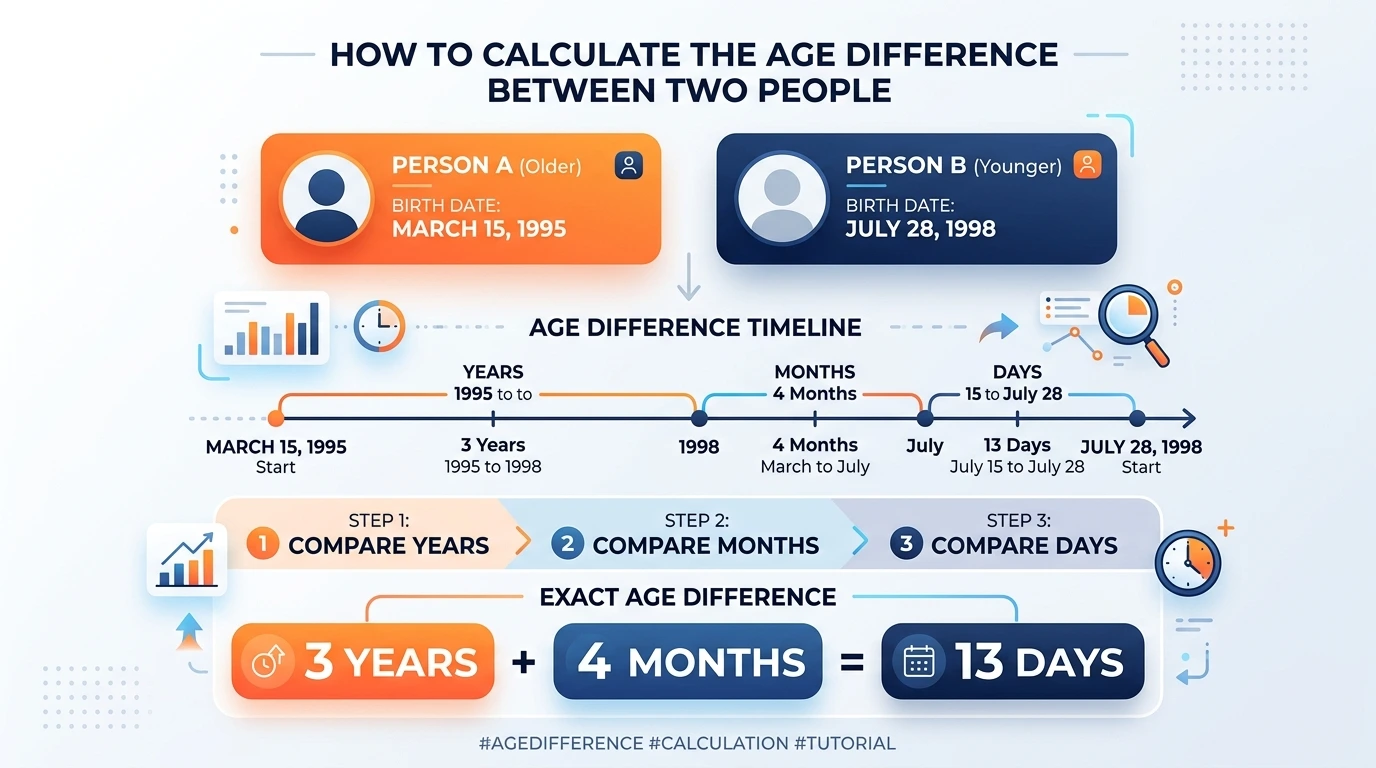
How to calculate the age difference between two people
The process is simple: First, enter the first person's date of birth. Then enter the second person's date of birth. The calculator compares the two dates and determines the difference.
The direction of the comparison matters. If Person A was born before Person B, Person A is older. If Person B was born before Person A, Person B is older. A useful calculator makes this clear.
Birthday calculator
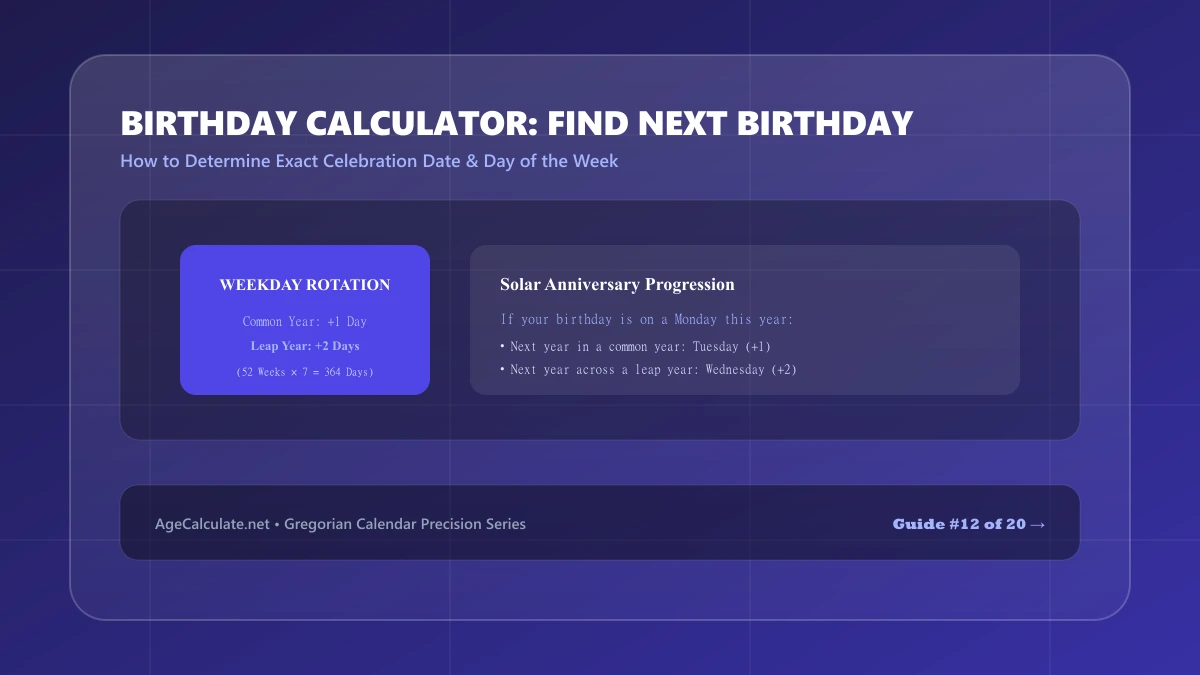
Age and birthdays are closely connected, but they are not exactly the same calculation. An age calculator answers How old are you? A birthday calculator answers questions such as When is your next birthday? or How long until my birthday?
Once you calculate your age, checking your next birthday is a natural next step. If your birthday has already happened this year, your next birthday will occur next year. If your birthday has not happened yet, the next birthday is still ahead in the current year. The calculation therefore depends on today's date and your birth month and day.
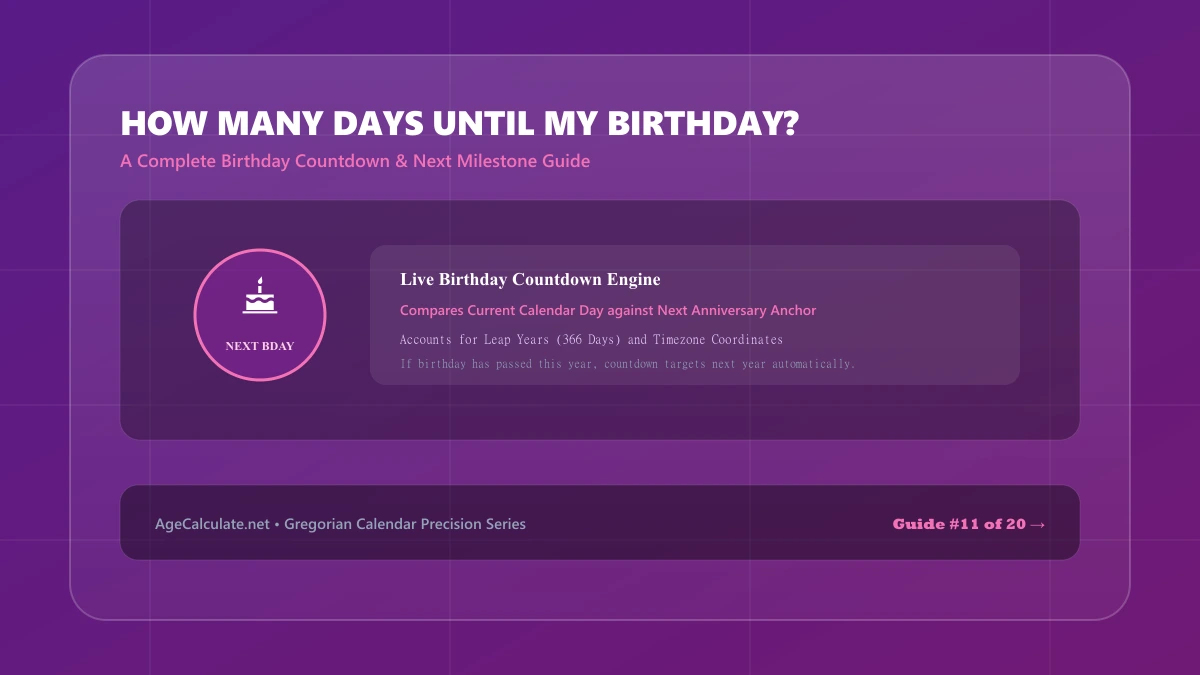
How many days until my birthday?
A birthday countdown compares today's date with your next birthday. The first step is identifying which birthday comes next. If your birthday is still ahead this year, use that date. If it has already passed, move to the same month and day in the following year. Then calculate the number of days between today and that birthday.
Leap years can affect the total number of days between the dates. That is another reason a date calculator is preferable to a rough mental estimate when you want an exact countdown.
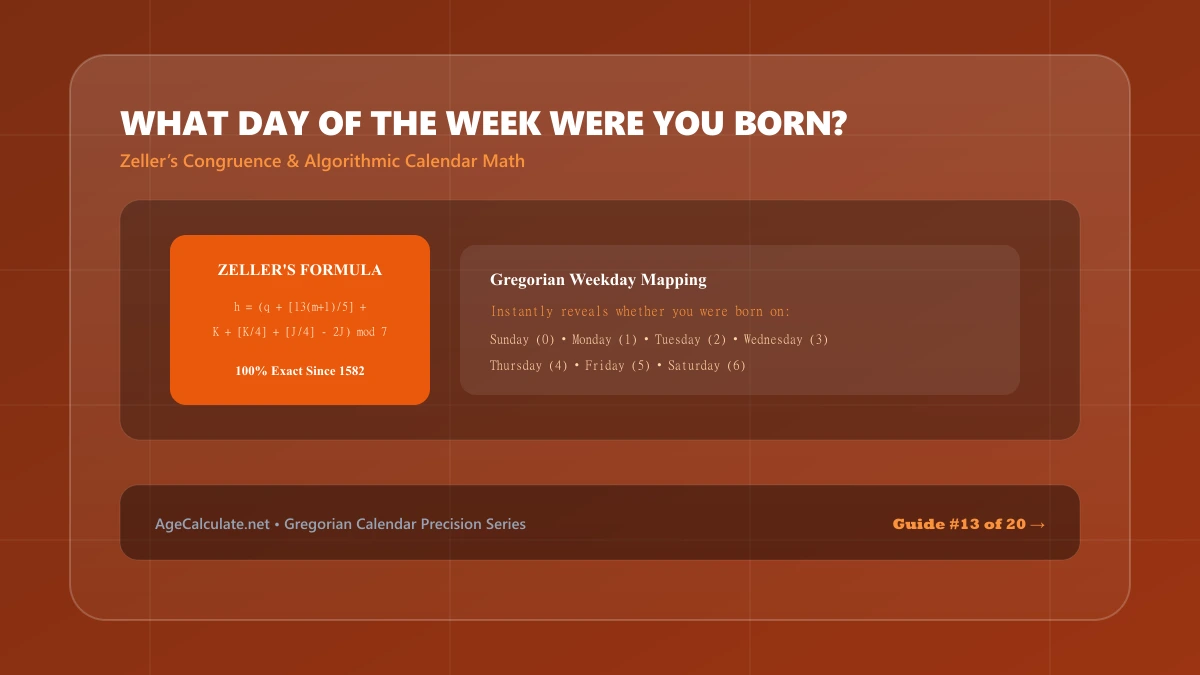
What day of the week was I born?
Your date of birth can tell you something else that an age calculation does not: the day of the week on which you were born (Monday through Sunday). This is a separate calendar calculation, but it fits naturally alongside age and birthday tools because they all begin with the same basic information: a date.
Leap years and February 29 birthdays
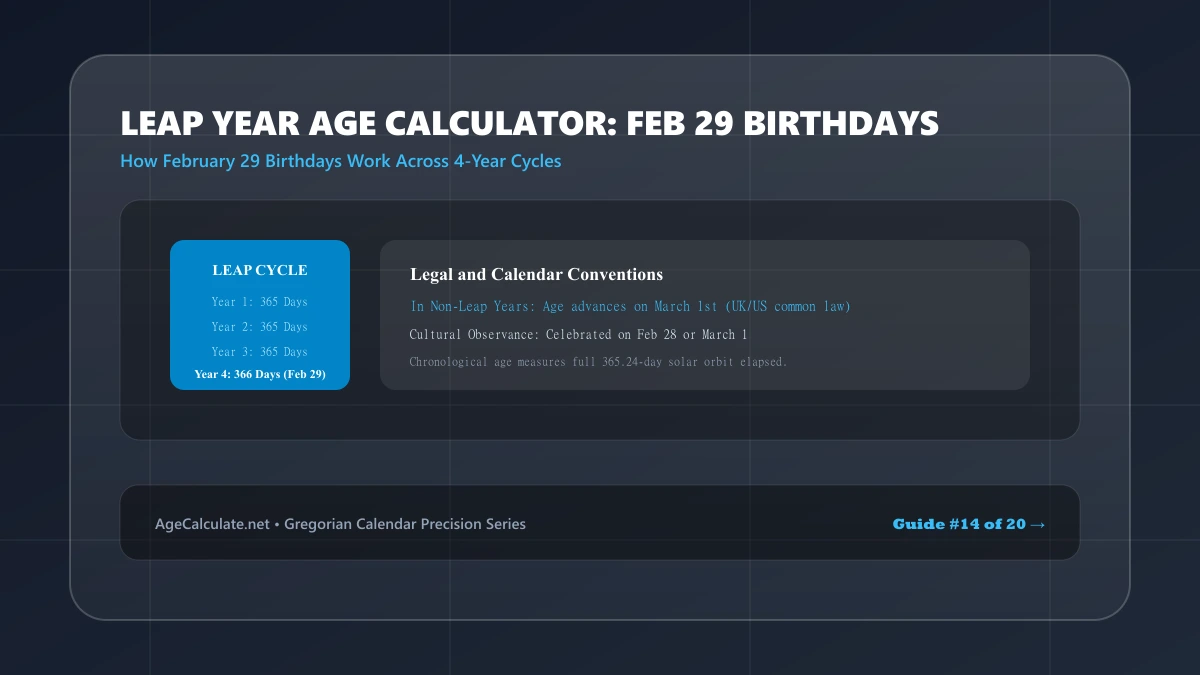
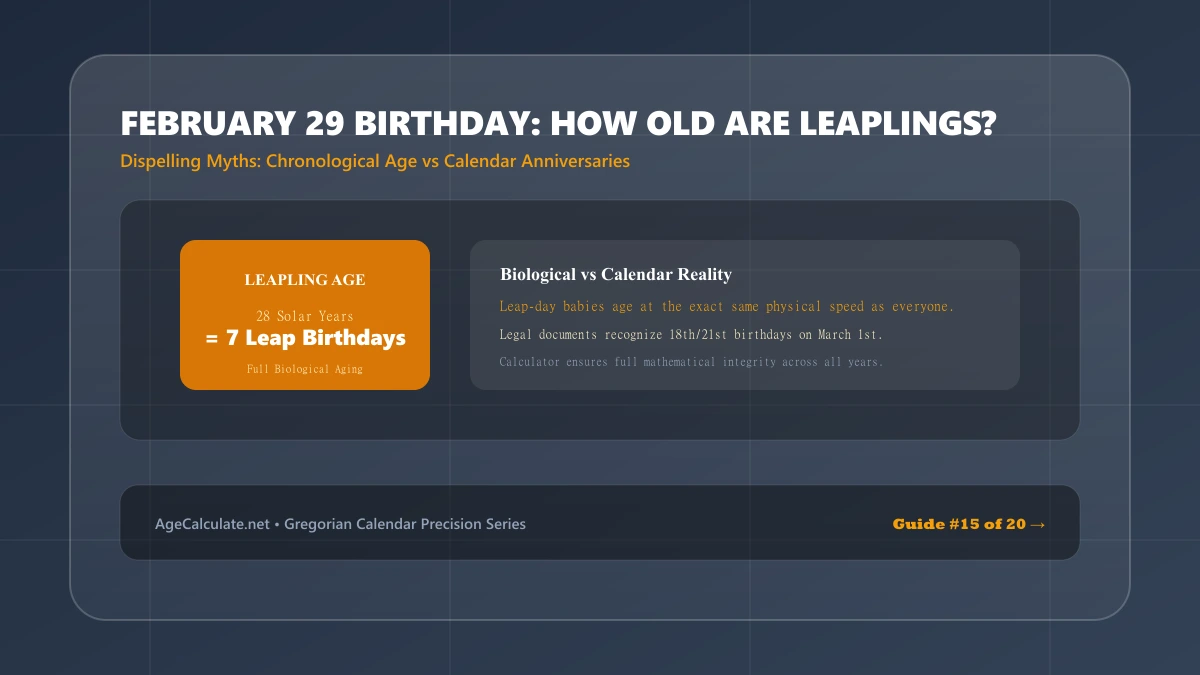
February 29 is one of the dates that deserves special attention when working with age. Most calendar years do not contain February 29. Leap years do.
A person born on February 29 therefore has a birth date that does not appear on the calendar every year. This creates an important distinction between the person's actual date of birth and how birthdays may be observed in non-leap years.
An age calculator needs a consistent rule for handling February 29. The underlying age calculation should remain based on calendar dates, while any birthday-specific behavior should be explained clearly.
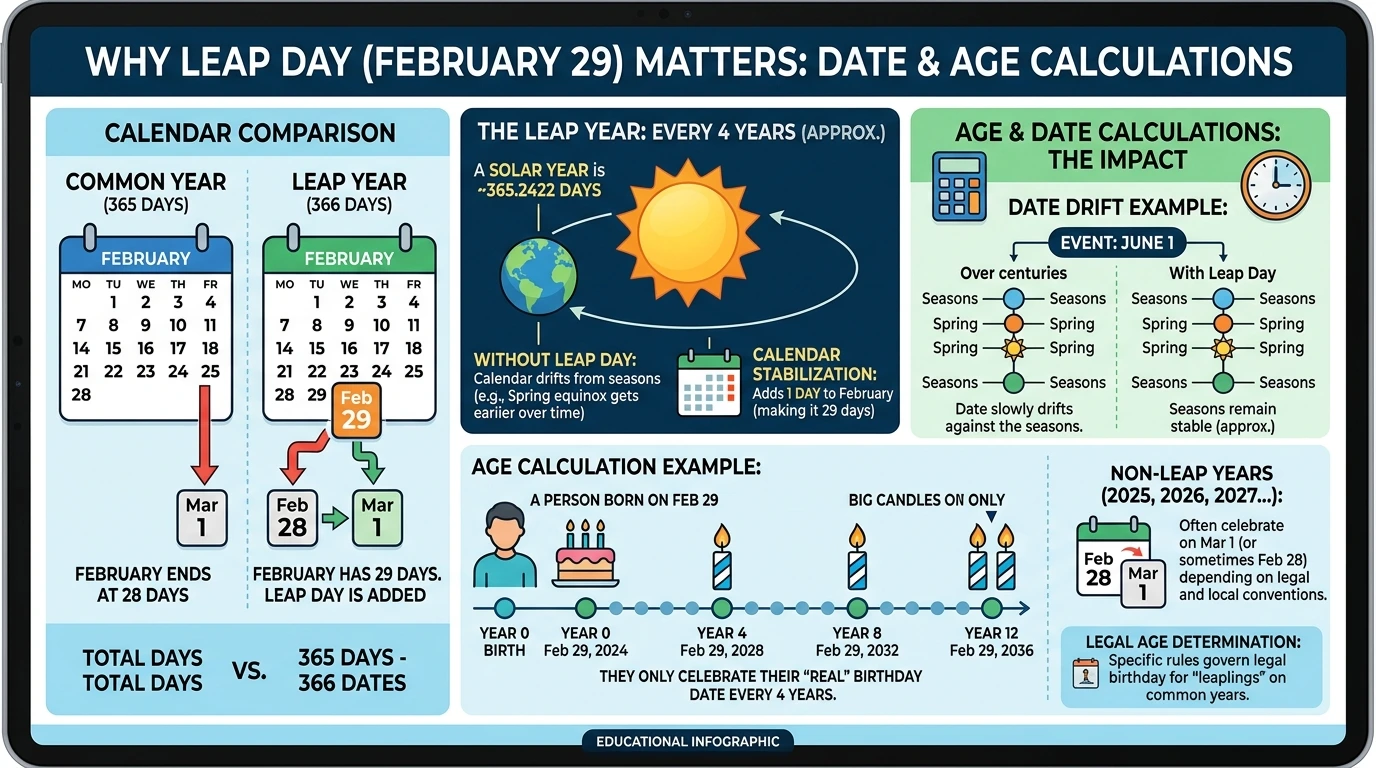
Age calculation and leap years
Leap years matter beyond February 29 birthdays. They also affect calculations involving total elapsed days. A period that crosses a leap year contains an additional calendar day compared with a comparable period that does not.
This matters when you ask How many days old am I? It matters less when you are simply asking How old am I in completed years? The distinction is worth remembering: calendar age and elapsed-day age are related, but they are not calculated in exactly the same way.
India and USA date formats
Age calculators are used internationally, and date formatting is one area where international users can easily run into confusion.
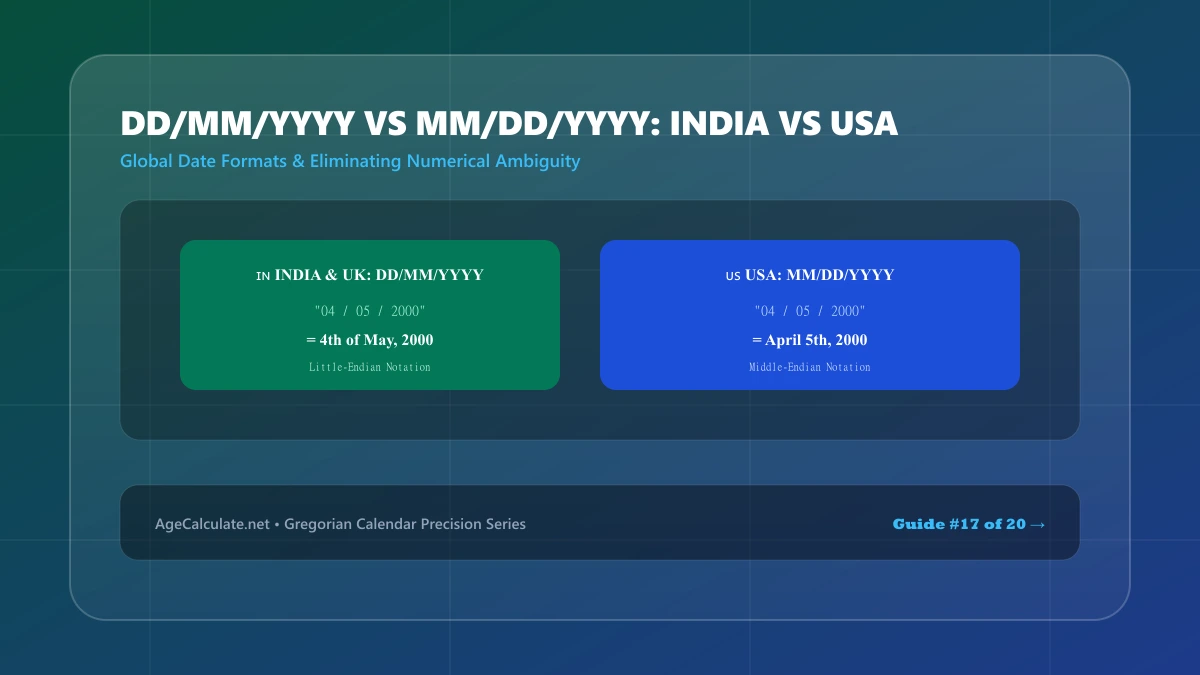
In India, dates are commonly written using the day/month/year order (e.g. 05/08/2000 means 5 August 2000). In the United States, dates are commonly written using the month/day/year order. The same numbers can therefore be interpreted differently.
A global age calculator should avoid making users guess. Instead of displaying an ambiguous input such as 05/08/2000, it is clearer to use separate fields: Day: 05, Month: August, Year: 2000. This approach works well for users in India, the USA, and other parts of the world because the meaning of each field is explicit.
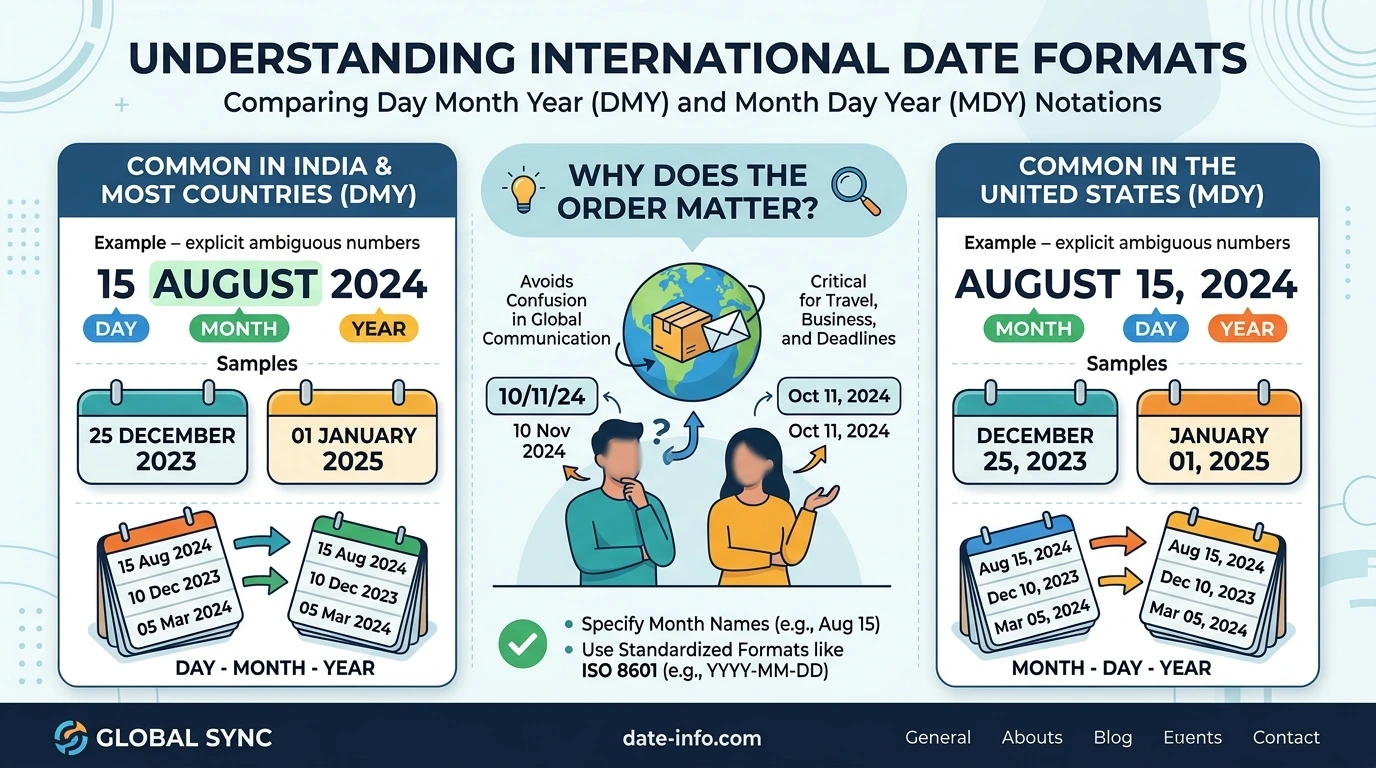
Why an international age calculator should use clear date fields
Imagine entering 04/05/1998. What does that mean? For one reader it could mean April 5. For another it could mean May 4. Nothing about the numbers themselves resolves the ambiguity.
This is particularly important for an age calculator because changing the interpretation of the birth date can completely change the result. The simplest solution is to label the components: Day, Month, Year. That removes unnecessary uncertainty before the calculation even begins.
Why simply subtracting birth years can be wrong
A common manual calculation looks like this: 2026 − 1998 = 28. That answer may be correct, but it may also be one year too high.
The missing question is: Has the person's birthday happened yet in 2026? If it has, the person is 28. If it has not, the person is still 27. This is the most common reason a quick age calculation can disagree with an age calculator.
Why months cannot always be converted into a fixed number of days
Another common mistake is assuming that every month contains the same number of days. It does not. Calendar months have different lengths. That means a statement such as 1 month = 30 days can be useful as an approximation in some contexts, but it is not a reliable definition of an exact calendar month.
The same issue appears when calculating an exact age. If someone asks for 32 years, 3 months, and 5 days, the calculation should follow the calendar dates rather than converting everything into an approximate number of days and then converting it back.
Common age calculation mistakes
- Using only the birth year: The birth month and day determine whether the next birthday has already happened.
- Forgetting the reference date: If you are calculating age on a historical or future date, today's date is not necessarily relevant.
- Mixing date formats: A date such as 03/04/2001 can mean different things in different countries. Use clearly labeled date fields.
- Treating months as equal: Calendar months have different numbers of days.
- Ignoring leap years: Leap years affect elapsed-day calculations and February 29.
- Confusing age with elapsed time: Being 30 years old is not the same thing as saying that exactly 30 × 365 days have elapsed since birth.
- Relying on an approximate calculation when precision matters: When the exact result matters, use the complete dates.
When is an age calculator useful?
Most people will use an age calculator simply because they want a quick answer. But there are several situations where it becomes particularly useful:
- Checking your exact age: When you want the precise years-months-days result.
- Checking a child's age: Especially during early years when months and days are more meaningful.
- Comparing two ages: To show precisely how far apart two birthdays are.
- Looking back at an event: Calculate how old you were on a particular past date.
- Looking ahead: Determine how old you will be on a future date.
- Planning a birthday: Show when the next birthday occurs and how many days remain.
- Exploring elapsed time: Calculate age in days, weeks, months, hours, minutes, or seconds.
- Checking calendar information: Find the weekday on which you were born.
Can I use an age calculator for someone else?
Yes. The calculation does not depend on whose date of birth you enter. You can calculate: your own age, a child's age, a parent's age, a partner's age, a friend's age, the age of a historical person, or the age difference between two people. The basic requirement is having the relevant date of birth.
Can I calculate an age without knowing the exact birth day?
Not if you want a fully exact calendar age. Knowing only the birth year can give you an approximate range. For an exact age in years, months, and days, use the complete date of birth whenever it is available.
Frequently asked questions
How do I calculate my age?
▼
Enter your date of birth and compare it with today's date. The calculator can determine your completed age and, where supported, show additional months and days.
What is an exact age calculator?
▼
An exact age calculator uses the complete date of birth and calculation date to determine age more precisely than simply subtracting the two years.
How do I calculate age from DOB?
▼
Enter the day, month, and year of the date of birth. The calculator compares that date with the current or selected reference date.
How do I calculate my age in years, months, and days?
▼
Compare your date of birth with the calculation date. First determine the completed years, then calculate the remaining calendar months and days.
How do I calculate my age on a specific date?
▼
Use the specific date as the reference date instead of today's date.
Can I calculate my age on a past date?
▼
Yes. Enter your date of birth and the historical date you want to use as the reference date.
Can I calculate my age on a future date?
▼
Yes. A future date can be used as the reference date to determine your completed age at that point.
How do I calculate the age difference between two people?
▼
Enter both dates of birth and compare the two dates. The result can be expressed in years, months, and days where supported.
How many days old am I?
▼
Calculate the elapsed number of calendar days between your date of birth and the selected reference date.
How many weeks old am I?
▼
Calculate the elapsed days and express that period in weeks. Exact handling depends on the calculator's output rules.
How many months old am I?
▼
A calculator can determine the completed calendar months between the relevant dates. This can be particularly useful for younger children.
Does a leap year affect age?
▼
Leap years affect calendar calculations, particularly elapsed-day calculations and dates involving February 29.
What happens if I was born on February 29?
▼
February 29 occurs only in leap years. A calculator should use a clearly defined rule for birthday-related calculations in years when February 29 does not occur.
Is age calculated by subtracting birth years?
▼
Not always. Year subtraction must be adjusted according to whether the birthday has already occurred in the reference year.
Can an age calculator work for users in India?
▼
Yes. The calculator can be used in India as long as the date input is entered correctly. Clearly labeled day, month, and year fields help avoid confusion.
Can an age calculator work for users in the USA?
▼
Yes. Users in the United States can use the same date-based calculation. Because US date notation commonly places the month before the day, explicit input labels are useful.
What is the difference between an age calculator and a birthday calculator?
▼
An age calculator determines how old someone is. A birthday calculator focuses on the date of a birthday, such as the next birthday or the number of days remaining until it.
Can I calculate the day I was born?
▼
Yes. A date-of-birth calculation can determine the weekday associated with your birth date.
Explore related date calculators
Once you know your age, you may want to answer another date-related question.
These tools work together because they all solve related date and calendar problems. They should be linked where the next calculation is genuinely useful to the reader.
A better way to work with dates
Date calculations become much easier when you stop treating dates as three independent numbers.
A date is a point on a calendar. Your birth date establishes one point. Today, a past event, or a future milestone establishes another. The calculation tells you what happened between those points.
That is the idea behind the age calculator. You do not need to remember which months have 30 or 31 days. You do not need to manually check whether your birthday has happened yet. You do not need to count leap-year days yourself.
Enter the dates, and let the calculator handle the calendar arithmetic.
For a quick current-age calculation, use your date of birth and today's date. For a historical question, use the date of the event. For a future question, use the date you are interested in. For an age comparison, enter both dates of birth. The question determines the calculation.
Calculate your age now
Your date of birth is enough to get started. Enter your Day, Month, and Year at the top of the page, then select Calculate My Age.
Back to Calculator ↑
📚 Complete Library
Educational Guides
Comprehensive deep-dives into date mathematics, leap years, international standards, and pediatric milestones.